CORE PERCUSSION SOUNDS
This chapter delves into the essential percussion sounds integral to modern music production. Each section focuses on a specific drum or percussion element, such as the kick, snare, hi-hats, and more. I've included valuable information for all technical levels, detailing unique sound characteristics, frequency ranges, and typical uses in various genres. By examining these elements, you'll learn to recognize common percussive sounds in a production and understand the role each element plays in evoking emotion and energy changes. To enrich your experience, I've included QR codes next to each illustration. Scanning these codes will allow you to hear examples of each sound, providing a practical understanding of their applications.
KICK/BASS DRUM
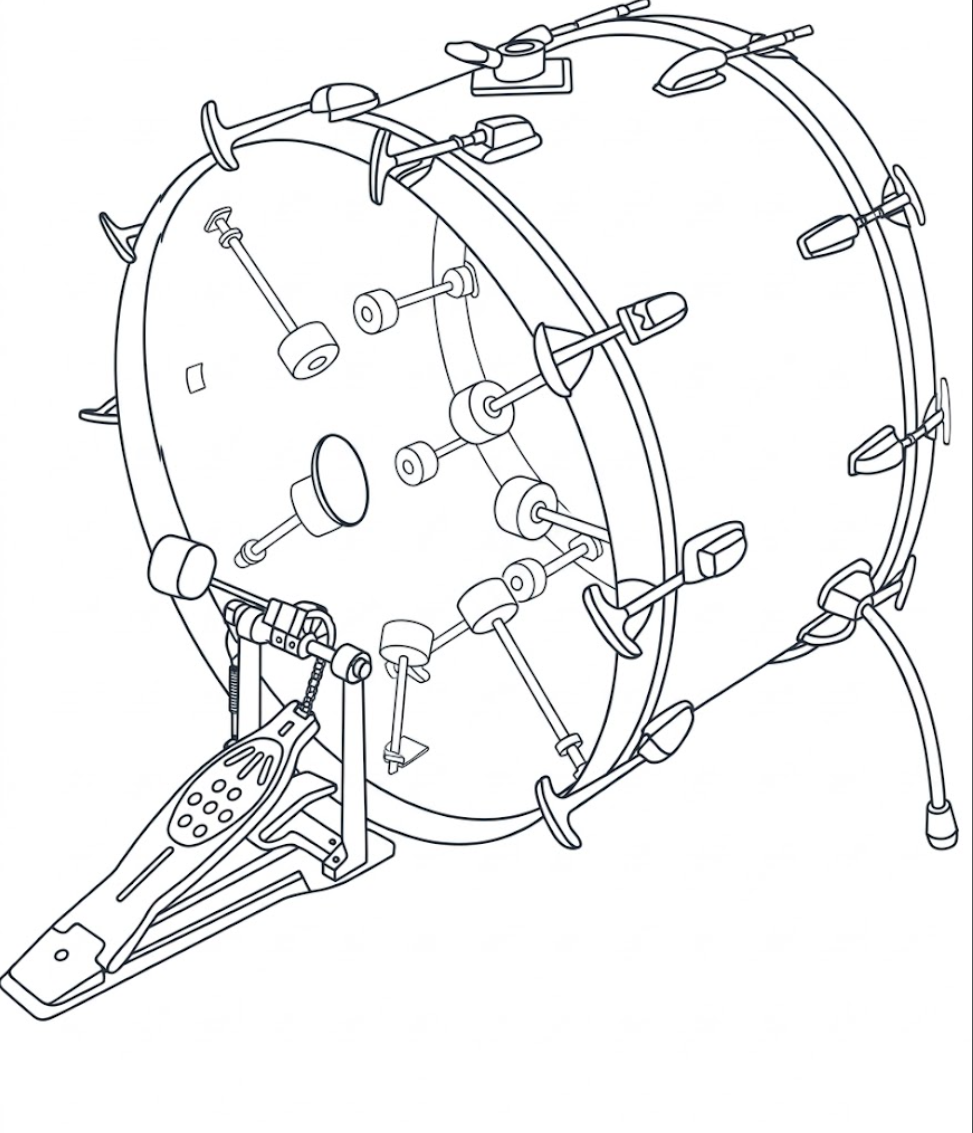
The kick drum, or bass drum, is a large, cylindrical drum with a diameter typically ranging from 18 to 26 inches (45 to 66 cm). It produces a deep, low-frequency thud essential in almost all contemporary music genres. Positioned horizontally on the floor and played with a foot pedal, it serves as the fundamental pulse of a track, providing a steady, anchoring rhythm that drives the tempo and establishes the beat's foundation. The fundamental frequency range of the kick drum generally falls between 50 Hz and 100 Hz, with harmonics extending higher.
SNARE
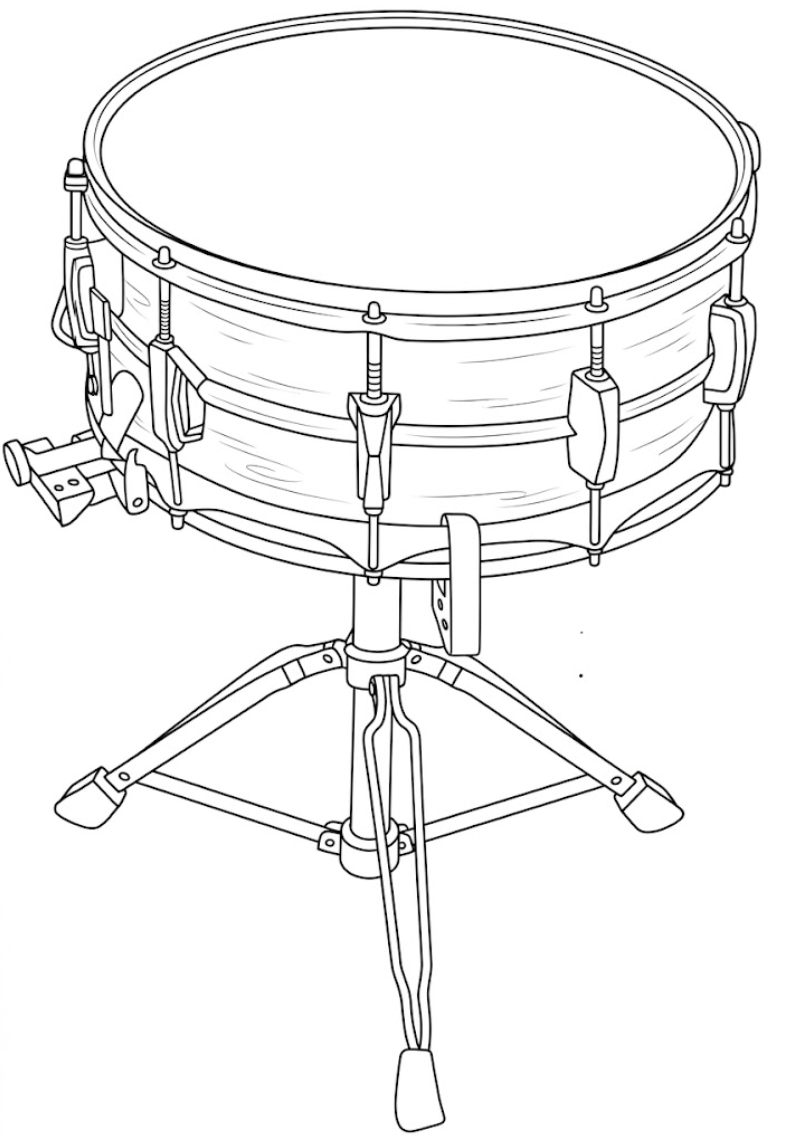
The snare drum is a cylindrical drum with a depth ranging from 5 to 8 inches (13 to 20 cm) and a diameter of about 14 inches (35 cm). It has metal wires, known as snares, stretched across the bottom head, producing a sharp, crisp sound that contrasts with the low thud of the kick drum. Typically placed on the second and fourth beats in common time, the snare's snapping character adds dynamic variation and rhythmic definition to the beat. The fundamental frequency range of the snare drum is usually between 100 Hz and 250 Hz, with the crisp "snap" sound occurring around 2 kHz to 4 kHz, and harmonics extending higher.
TAMBOURINE
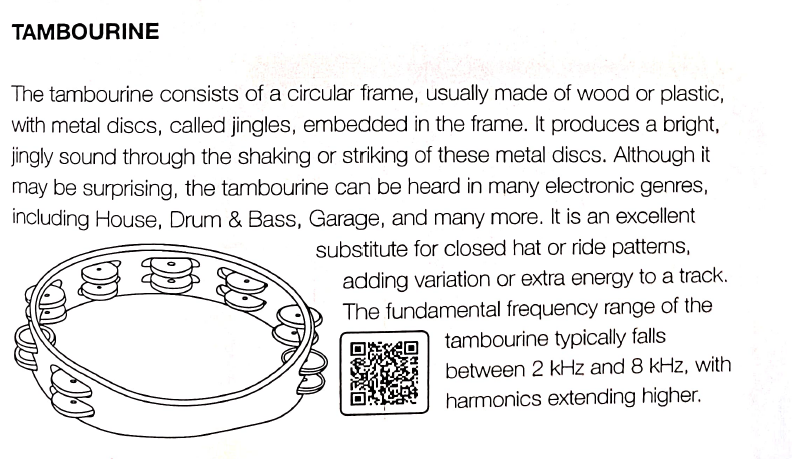
The tambourine consists of a circular frame, usually made of wood or plastic, with metal discs, called jingles, embedded in the frame. It produces a bright, jingly sound through the shaking or striking of these metal discs. Although it may be surprising, the tambourine can be heard in many electronic genres, including House, Drum & Bass, Garage, and many more. It is an excellent substitute for closed hat or ride patterns, adding variation or extra energy to a track. The fundamental frequency range of the tambourine typically falls between 2 kHz and 8 kHz, with harmonics extending higher.
OPEN HIGH HAT
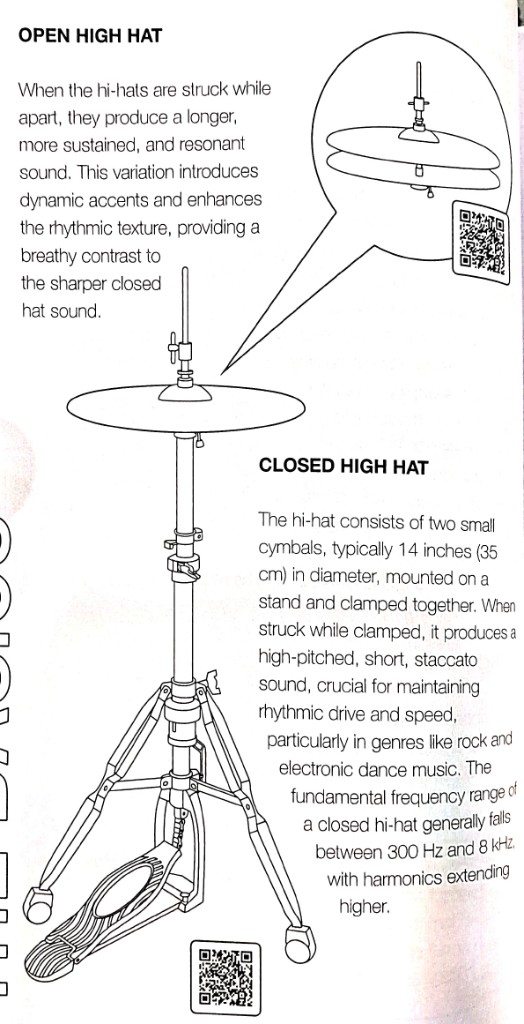
When the hi-hats are struck while apart, they produce a longer, more sustained, and resonant sound. This variation introduces dynamic accents and enhances the rhythmic texture, providing a breathy contrast to the sharper closed hat sound.
CLOSED HIGH HAT
The hi-hat consists of two small cymbals, typically 14 inches (35 cm) in diameter, mounted on a stand and clamped together. When struck while clamped, it produces a high-pitched, short, staccato sound, crucial for maintaining rhythmic drive and speed, particularly in genres like rock and electronic dance music. The fundamental frequency range of a closed hi-hat generally falls between 300 Hz and 8 kHz, with harmonics extending higher.
CRASH CYMBAL
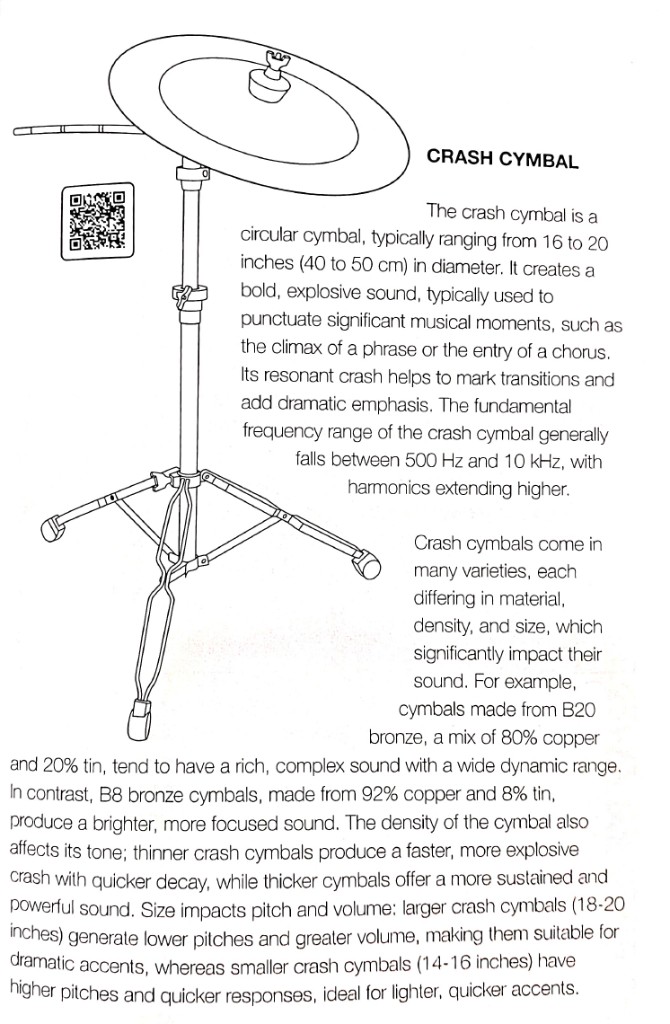
The crash cymbal is a circular cymbal, typically ranging from 16 to 20 inches (40 to 50 cm) in diameter. It creates a bold, explosive sound, typically used to punctuate significant musical moments, such as the climax of a phrase or the entry of a chorus. Its resonant crash helps to mark transitions and add dramatic emphasis. The fundamental frequency range of the crash cymbal generally falls between 500 Hz and 10 kHz, with harmonics extending higher.
Crash cymbals come in many varieties, each differing in material, density, and size, which significantly impact their sound. For example, cymbals made from B20 bronze, a mix of 80% copper and 20% tin, tend to have a rich, complex sound with a wide dynamic range. In contrast, B8 bronze cymbals, made from 92% copper and 8% tin, produce a brighter, more focused sound. The density of the cymbal also affects its tone; thinner crash cymbals produce a faster, more explosive crash with quicker decay, while thicker cymbals offer a more sustained and powerful sound. Size impacts pitch and volume: larger crash cymbals (18-20 inches) generate lower pitches and greater volume, making them suitable for dramatic accents, whereas smaller crash cymbals (14-16 inches) have higher pitches and quicker responses, ideal for lighter, quicker accents.
RIDE CYMBAL
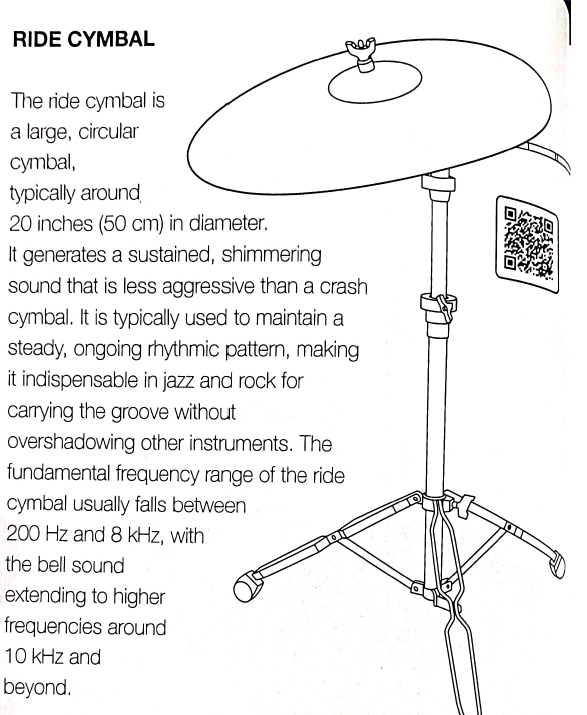
The ride cymbal is a large, circular cymbal, typically around 20 inches (50 cm) in diameter. It generates a sustained, shimmering sound that is less aggressive than a crash cymbal. It is typically used to maintain a steady, ongoing rhythmic pattern, making it indispensable in jazz and rock for carrying the groove without overshadowing other instruments. The fundamental frequency range of the ride cymbal usually falls between 200 Hz and 8 kHz, with the bell sound extending to higher frequencies around 10 kHz and beyond.
CLAVES
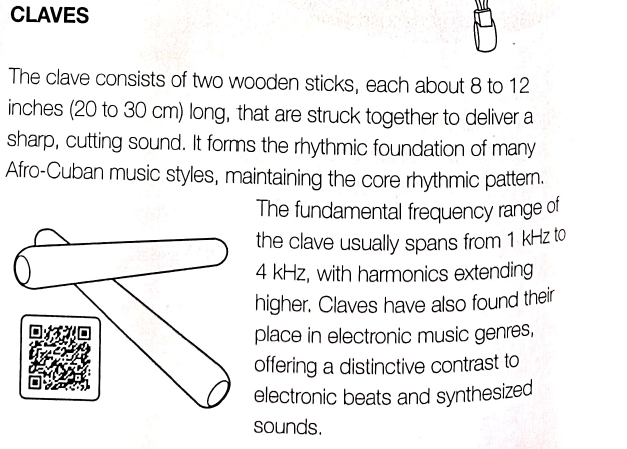
The clave consists of two wooden sticks, each about 8 to 12 inches (20 to 30 cm) long, that are struck together to deliver a sharp, cutting sound. It forms the rhythmic foundation of many Afro-Cuban music styles, maintaining the core rhythmic pattern. The fundamental frequency range of the clave usually spans from 1 kHz to 4 kHz, with harmonics extending higher. Claves have also found their place in electronic music genres, offering a distinctive contrast to electronic beats and synthesized sounds.
TOMS
Toms are cylindrical drums with variable diameters and depths, producing tones that range from high to deep and resonant. They are primarily used for fills and rhythmic sequences during transitions within songs, adding depth and dramatic flair to drumming patterns. The fundamental frequency range of toms varies, with small toms typically ranging from 100 Hz to 400 Hz and floor toms from 60 Hz to 200 Hz, with harmonics extending higher.
The illustration above depicts a roto-tom, a type of tom that features an open frame design. Roto-toms can be rotated to tighten or loosen the drumhead membrane, allowing for precise pitch adjustments during performance.
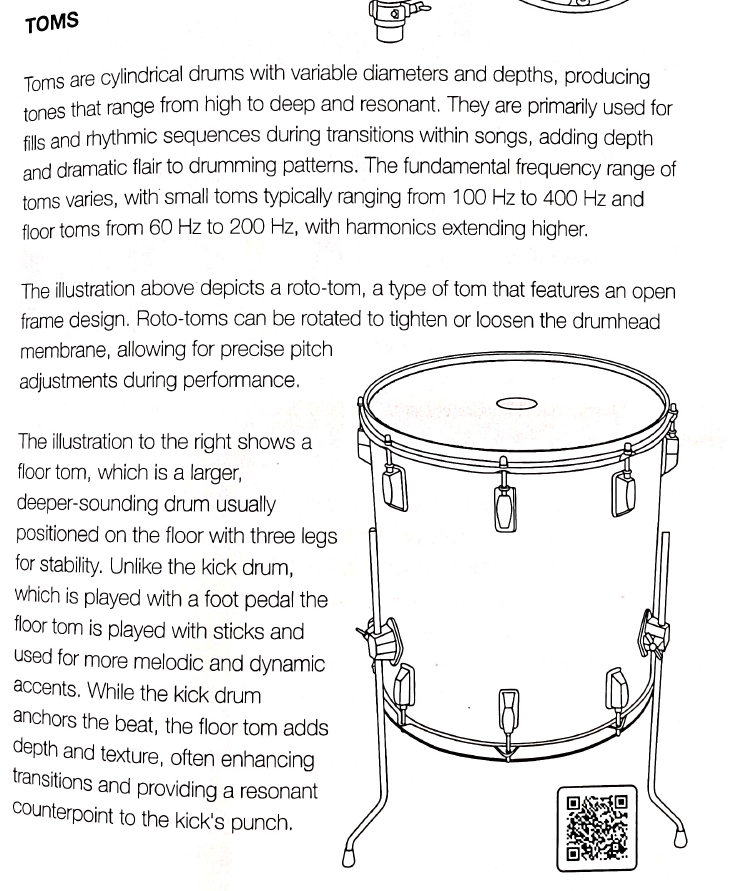
The illustration to the right shows a floor tom, which is a larger, deeper-sounding drum usually positioned on the floor with three legs for stability. Unlike the kick drum, which is played with a foot pedal the floor tom is played with sticks and used for more melodic and dynamic accents. While the kick drum anchors the beat, the floor tom adds depth and texture, often enhancing transitions and providing a resonant counterpoint to the kick's punch.
SHAKER
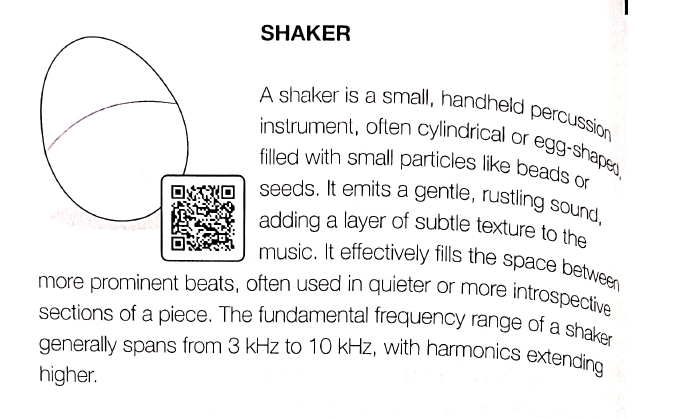
A shaker is a small, handheld percussion instrument, often cylindrical or egg-shaped, filled with small particles like beads or seeds. It emits a gentle, rustling sound, adding a layer of subtle texture to the music. It effectively fills the space between more prominent beats, often used in quieter or more introspective sections of a piece. The fundamental frequency range of a shaker generally spans from 3 kHz to 10 kHz, with harmonics extending higher.
808 KICK
The 808 bass drum sound originates from the Roland TR-808 drum machine, an electronic device released in 1980. Initially, the TR-808 was not commercially successful and was discontinued after only three years due to the unavailability of crucial components. The TR-808 is capable of synthesizing and sequencing a wide variety of drum and percussion sounds, including snares, hi-hats, and cymbals. Despite this versatility, it became most recognized for its ability to produce a sustained and tonal kick sound that has become a hallmark in hip-hop, trap, and electronic music. This synthesized sound is frequently used both rhythmically and melodically to support the harmonic structure of a track. The fundamental frequency range of the 808 typically spans from 20 Hz to 60 Hz, with harmonics that can extend higher.
STABS
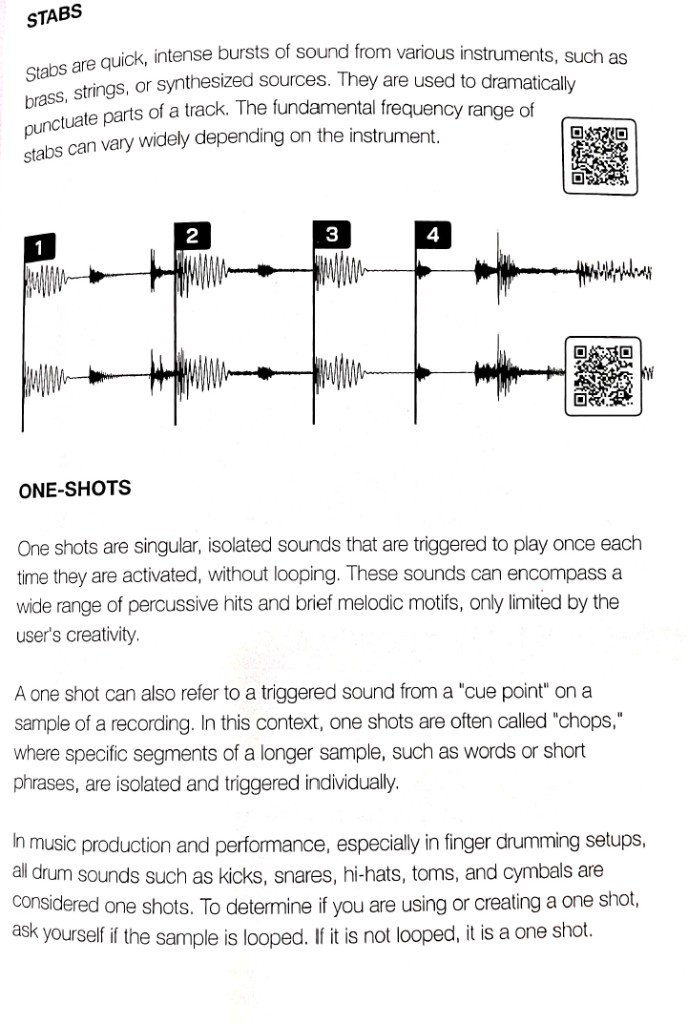
Stabs are quick, intense bursts of sound from various instruments, such as brass, strings, or synthesized sources. They are used to dramatically punctuate parts of a track. The fundamental frequency range of stabs can vary widely depending on the instrument.
ONE-SHOTS
One shots are singular, isolated sounds that are triggered to play once each time they are activated, without looping. These sounds can encompass a wide range of percussive hits and brief melodic motifs, only limited by the user's creativity.
A one shot can also refer to a triggered sound from a "cue point" on a sample of a recording. In this context, one shots are often called "chops," where specific segments of a longer sample, such as words or short phrases, are isolated and triggered individually.
In music production and performance, especially in finger drumming setups, all drum sounds such as kicks, snares, hi-hats, toms, and cymbals are considered one shots. To determine if you are using or creating a one shot, ask yourself if the sample is looped. If it is not looped, it is a one shot.