THE BASICS
BEATS, RHYTHM, AND TIMING
Rhythm is a fundamental element of music, shaping its flow and giving it life. It determines the pattern of sounds and silences, guiding how a piece moves through time. Understanding rhythm involves grasping several key concepts, including Beats Per Minute (BPM), note values, and time signatures.
WHAT IS RHYTHM?
Rhythm is a sequence of musical notes and rests in time, defining when a note should be played and for how long. It drives the pace and feel of the music, making it lively, mellow, or somewhere in between.
BEATS PER MINUTE (BPM)
BPM measures the tempo of a piece, indicating how many beats occur in one minute. Different musical genres have typical BPM ranges, such as 115-130 BPM for House music and 160-180 BPM for Drum & Bass. In this document, we provide rhythm patterns with corresponding BPMs.
COUNTING BPM WITH A METRONOME
A metronome is a valuable tool for counting BPM and maintaining a steady tempo. It ticks at a consistent pace, which you can set to the desired BPM. Practicing with a metronome strengthens your sense of timing, helping you become a more proficient musician. If you don't have a physical metronome, consider using a smartphone app.
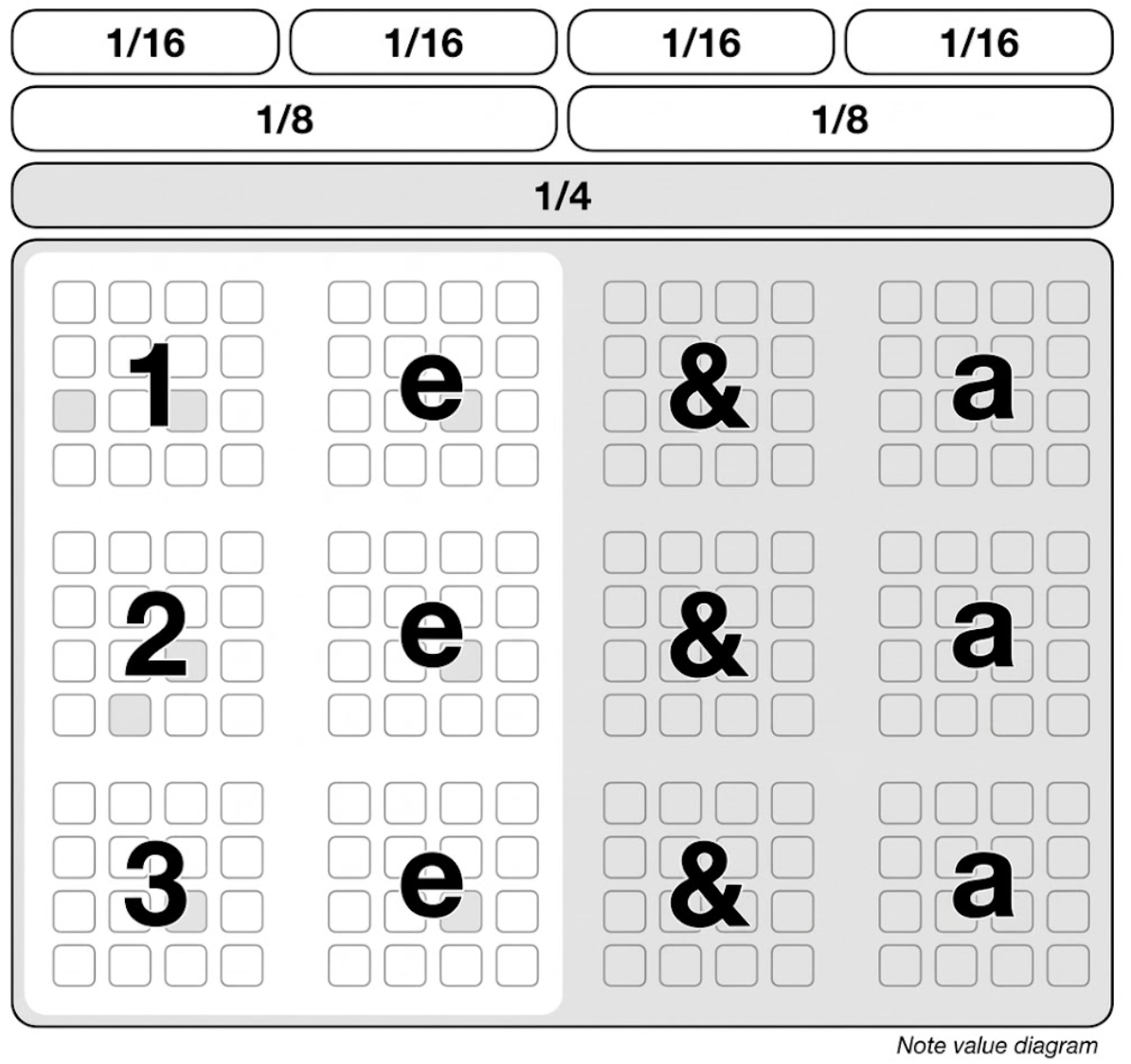
QUARTER NOTES (1/4)
Explanation: Quarter notes are a fundamental rhythmic notation, representing a single beat in 4/4 time, the most common time signature. One quarter note per beat forms the foundation of rhythm.
Visual Representation: In the Finger Drum Bible Series, a quarter note is visually represented as the first grid of each row, unless indicated otherwise. This shows its consistent presence at the start of each measure.
Counting Quarter Notes: To count quarter notes, each beat corresponds to a single quarter note. In a measure of 4/4 time, count "1, 2, 3, 4," with each number marking a quarter note.
EIGHTH NOTES (1/8)
Explanation: Eighth notes are rhythmic units worth half a beat in 4/4 time, making them twice as fast as quarter notes.
Visual Representation: In the Finger Drum Bible Series, eighth notes are represented by the first and third grids of each row, unless indicated otherwise, showing their quicker, alternating nature.
Counting Eighth Notes: Counting eighth notes divides each beat into two parts. In 4/4 time, this is expressed as "1 and 2 and 3 and 4 and," with the numbers marking the main beats and the "and"s representing the eighth notes between them.
SIXTEENTH NOTES (1/16)
Explanation: Sixteenth notes are rhythmic units worth a quarter of a beat in 4/4 time, making them twice as fast as eighth notes.
Visual Representation: In the Finger Drum Bible Series, each grid represents a sixteenth note, unless specified otherwise, showing their rapid succession.
Counting 16th Notes: Counting 16th notes involves dividing each beat into four parts. In 4/4 time, this is counted as "1 e & a, 2 e & a, 3 e & a, 4 e & a," with each syllable representing a 16th note.
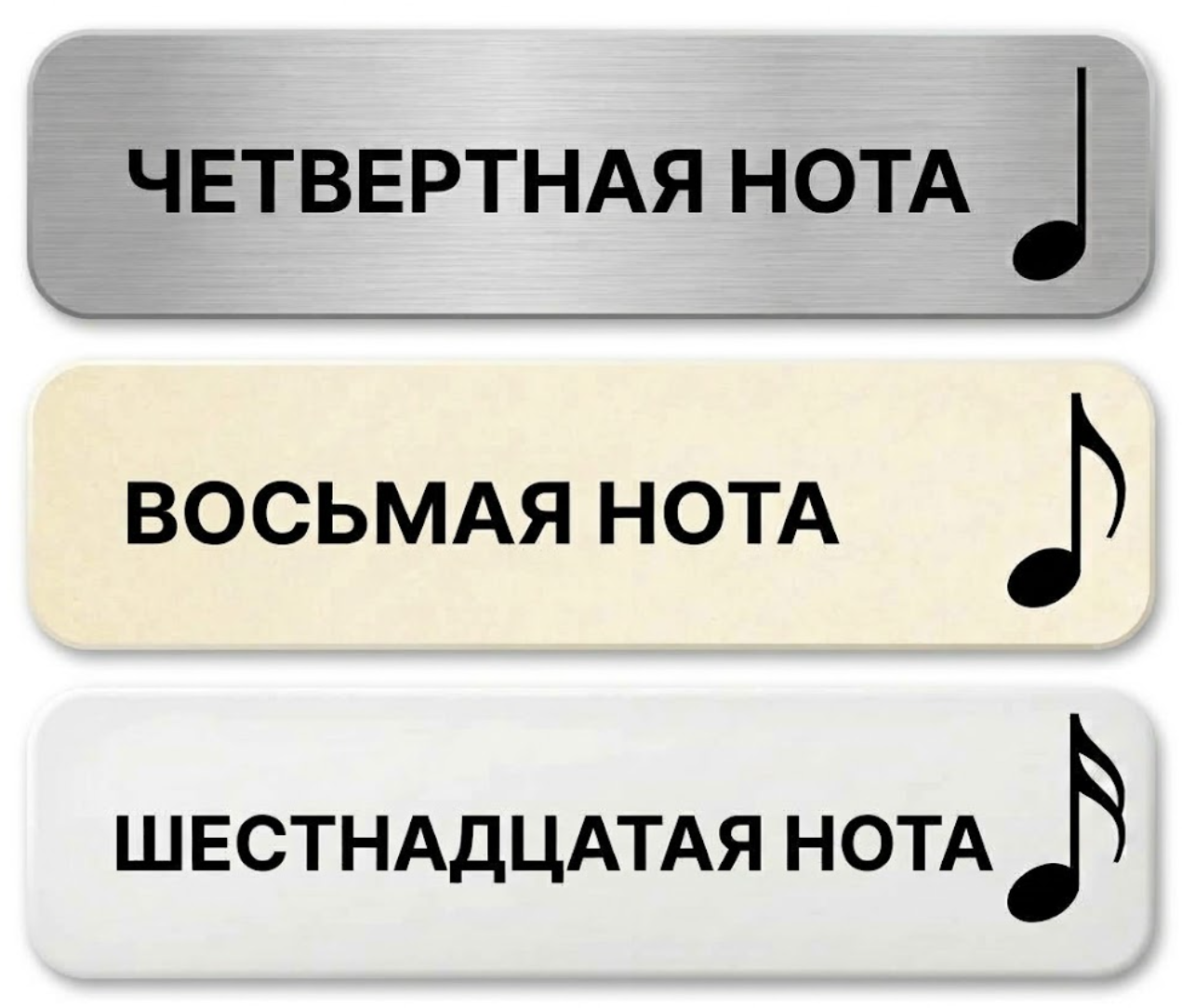
In traditional musical notation, time values for notes are represented using symbols consisting of different shapes and stems. These symbols are placed on a five-line system called a staff.
PRACTICING RHYTHM
Find a quiet space where you can concentrate. You'll need a metronome or a metronome app on your phone. This will help you maintain a steady tempo while practicing.
START SLOW
Set your metronome to a slow tempo, around 60-80 BPM, to begin. This tempo will allow you to focus on keeping time without feeling rushed.
CLAPPING OR TAPPING TO THE BEAT
Quarter Notes: Start by clapping or tapping your hand on a table to each beat of the metronome. This means one clap or tap per beat, creating a steady rhythm: "1, 2, 3, 4." Repeat this for several measures to get comfortable with the basic timing.
Eighth Notes: Once comfortable with quarter notes, practice dividing each beat into two. This means you'll clap or tap twice per beat. This creates a rhythm of "1 and 2 and 3 and 4 and," with the numbers representing the main beats and the "and"s marking the eighth notes.
16th Notes: Once comfortable with eighth notes, progress to 16th notes by dividing each beat into four. This involves a quick "1 e & a, 2 e & a, 3 e & a, 4 e & a," where each syllable represents a clap or tap.
PRACTICE ALONGSIDE MUSIC
Choose a Song: Select a song with a clear, steady beat that matches your comfort level.
Clap or Tap to the Beat: Begin clapping or tapping to the beat of the song. For an extra challenge, identify and clap or tap along with specific rhythmic patterns, such as the bassline or melody.
Count Aloud: To solidify your sense of timing, count aloud while clapping or tapping, '1, 2, 3, 4' for quarter notes or '1 and 2 and 3 and 4 and' for eighth notes.
GRADUALLY INCREASE TEMPO
Increase Metronome Speed: Once you're comfortable with slower tempos, gradually increase the BPM by 10-20 increments. This will help you adapt to different musical speeds.
Practice at Various Tempos: Work at different tempos, from slow to fast, until you feel comfortable with each.
RHYTHM EXERCISES
Alternating Rhythms: Alternate between quarter notes, eighth notes, and 16th notes within the same measure. This strengthens your rhythmic versatility.
Syncopation: For an advanced challenge, try clapping or tapping on the "off-beat," or between the main beats. This creates syncopation, giving your rhythm a more dynamic feel.
STAY CONSISTENT
Practice daily, even if for just a few minutes. Consistent practice helps reinforce your sense of rhythm and timing over time.
RECORD AND EVALUATE
Record Your Practice: Use a voice recorder or phone app to record your clapping or tapping.
Self-Evaluation: Listen to the recording and assess if your rhythm is steady and accurate. Make adjustments as needed and try again.
SWING
Swing is a rhythmic concept commonly associated with jazz music and its derivatives. Here's what it means:

SWING IN RHYTHM
STRAIGHT EIGHTS:
SWING FEEL:
Uneven Eighth Notes: In practice, swing often means playing eighth notes in an uneven pattern. For example, in a 4/4 time signature, straight eighth notes are evenly spaced at 1/2 of a beat each. In swing, the first eighth note (on the beat) is longer, taking up 2/3 of the beat, while the second eighth note (off-beat) is shorter, occupying 1/3 of the beat.
Groove: The combination of this uneven, laid-back feel gives swing music its characteristic "groove." This rhythm makes swing feel more fluid, relaxed, and bouncy compared to straight time.
SWING IN STYLE
Versatility: Swing isn't limited to jazz; it can be incorporated into many musical genres, such as rock, pop, and electronic music, to give them a different feel.
SWING IN PRACTICE
Interpretation: Musicians often interpret swing differently, ranging from subtle to pronounced. The degree of swing can vary greatly depending on the style and artist.
Grid Tablature: In the Finger Drum Bible series, including this book, swing isn't always explicitly notated. Instead, tablature might include a note indicating "swing feel," or it might be expected that you intuitively apply it based on genre conventions.